Snellius’ Law of Apparent Depth
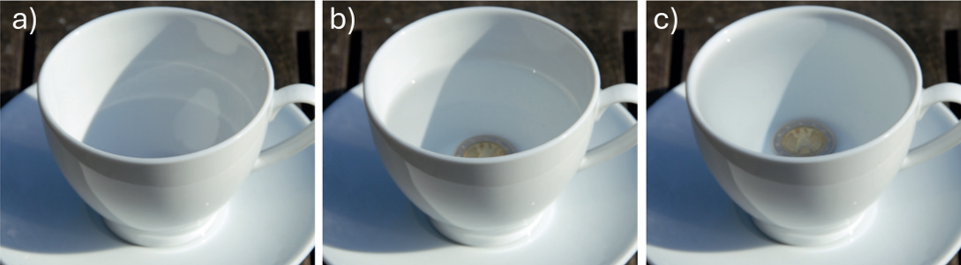
The law of refraction, also known as Snell’s law, describes the change in the direction of light as it passes between media of different optical density. In 1621, however, Snellius did not derive this law from a theoretical model of light—as Descartes later did in 1627—but developed it through experimental investigations of the phenomenon of apparent depth. He analyzed the relationship between the optical and haptic positions of objects submerged in water as a function of the viewing angle. In doing so, he identified a relationship that is equivalent to the sine law of refraction, yet derived directly from the observed phenomenon itself: the “law of apparent depth.”

On the history of the law of apparent depth
-
Quick, T. & Grebe-Ellis, J. (2025): Snellius’ law of refraction and the phenomenon of apparent depth, PhyDid B – Didactics of Physics. Contributions to the DPG Spring Conference, 2025 in Göttingen. (in preparation)
Abstract: The law of refraction, also known as Snell’s law, describes the change in the propagation direction of light when it passes between media of different optical density. In 1621, Snellius did not derive this law from a model of light—as Descartes later did in 1627—but formulated it on the basis of exploratory investigations of optical lifting. By examining the relationship between the optical and haptic positions of objects submerged in water for given viewing angles, he identified a relation that is equivalent to the sine law of refraction, yet formulated closer to the phenomenon itself: the “law of lifting.” In our contribution, we show how experimental, conceptual, and epistemological investigations of apparent depth in the historical context of Snellius’ discovery can be integrated at lower and upper secondary school levels. We analyze Snellius’ law of lifting, demonstrate its equivalence to the sine law of refraction, present the “experimentum elegans” in a modern form, and discuss his “cathetus rule” for vertical lifting. This culminates in a generalized theory of image formation that distinguishes between sagittal and meridional imaging. Finally, we discuss the “refractaria” (lifting conchoid), the curve describing the optical lifting of a horizontal line located under water.